

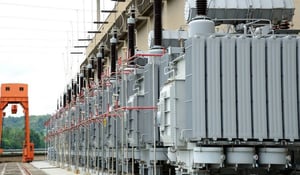
Detecting emerging (or “incipient”) faults inside large power transformers is one of the most difficult challenges in electrical engineering. Early-stage faults, such as localized winding degradation, micro-arcing, partial discharges, or minor hotspot development, occur deep within the machine.
Several physical, electrical, and chemical factors make detecting these emerging faults extremely difficult:
1. Minimal External Electrical Signatures
In their early stages, internal faults have almost zero impact on the transformer’s external terminal voltages and currents. For example, a minor short-circuit between two adjacent turns in a winding of thousands of turns (a “turn-to-turn fault”) changes the overall transformation ratio and primary current by fractions of a percent. Standard protective relays, which look for high overcurrents or current differentials, are completely blind to these minute shifts until the fault escalates catastrophically.
2. Sealed, Submerged, and Complex Physical Structures
Large power transformers are completely sealed steel tanks packed with massive amounts of copper windings, magnetic steel cores, and layered solid cellulose insulation (paper), all submerged in thousands of gallons of insulating oil.
- No line of sight: There is no visual access. Inspecting internal components requires shutting down the unit, draining the oil, and physically dismantling it—a process costing hundreds of thousands of dollars.
- Deeply buried faults: Failures often start deep within the winding layers or under structural clamps where external sensors cannot reach.
3. Signal Dilution and Attenuation
Because of the transformer’s dense physical barrier, the physical and chemical indicators of a fault are significantly muffled before they reach the tank’s exterior:
- Chemical dilution: When a small hotspot or partial discharge decomposes nearby insulation, it releases diagnostic gases (such as hydrogen, methane, or acetylene). However, these gases must slowly diffuse through a vast, moving volume of oil to reach sampling valves or online Dissolved Gas Analysis (DGA) sensors. By the time the gas reaches the sensor, it is highly diluted, making early detection a game of identifying parts-per-million (ppm) trends.
- Physical attenuation: Acoustic emissions (sound waves) or electromagnetic pulses generated by localized partial discharges (PD) degrade rapidly as they travel through layers of paper, oil, and thick steel tank walls, making them highly difficult to capture.
4. High Background “Noise” (Acoustic & Electromagnetic)
Transformers operate in harsh, noisy substation environments. This background noise easily masks the faint signals of an emerging fault:
- Mechanical noise: The constant hum of the magnetic core (magnetostriction), along with the vibrations of cooling fans and oil pumps, drowns out the faint acoustic clicks of mechanical deformation or early-stage partial discharges.
- Electrical noise: Substation switchyards are plagued by high-frequency electromagnetic interference (EMI) from corona discharges on transmission lines, radio signals, and switching transients, which mimic and overwhelm the electrical sensors used to monitor partial discharges.
5. Extreme Difficulty in “Pinpointing” (Localization)
Even if diagnostic tools (like oil testing) successfully signal that a fault exists, they rarely indicate where it is. A DGA test might reveal that paper insulation is burning, but it cannot tell you which of the three massive phases or thousands of winding layers is failing. Triangulating the physical source of acoustic or electrical signals inside a complex 3D metallic environment remains highly difficult due to signal reflection and multipath distortion inside the tank.
6. Transient System Events
Normal power grid operations can mask or mimic fault behavior. For example, when a transformer is first turned on (energized), it experiences a massive “inrush current” that can look like an internal short-circuit to sensitive sensors. Lightning strikes, external grid faults, and sudden load changes also place temporary thermal and mechanical stresses on the transformer, making it difficult for automated monitoring software to distinguish between a temporary external system disturbance and a real, emerging internal defect.
Detect Faults Before They Become Failures
Emerging transformer faults rarely announce themselves before they become costly problems. Detecting changes in moisture, gas generation, temperature, and electrical behaviour at an early stage requires the right combination of monitoring technologies and asset intelligence. At Insulect, we help utilities, renewable energy operators, industrial facilities, and service providers improve transformer reliability with industry-leading solutions, including dissolved gas analysis (DGA), bushing monitoring, temperature monitoring, and comprehensive transformer condition monitoring systems. If you're looking to strengthen your asset monitoring strategy and detect developing faults before they lead to unplanned outages, contact Insulect to discuss the right solution for your transformer fleet.
.gif?width=600&height=600&name=Images%20(600%20x%20600%20px).gif)