

Cable link boxes are critical components in High Voltage (HV) networks that significantly manage and reduce sheath voltage stress in underground power cables. They achieve this primarily by controlling induced voltages and circulating currents within the cable sheaths, which are metallic layers surrounding the conductor.
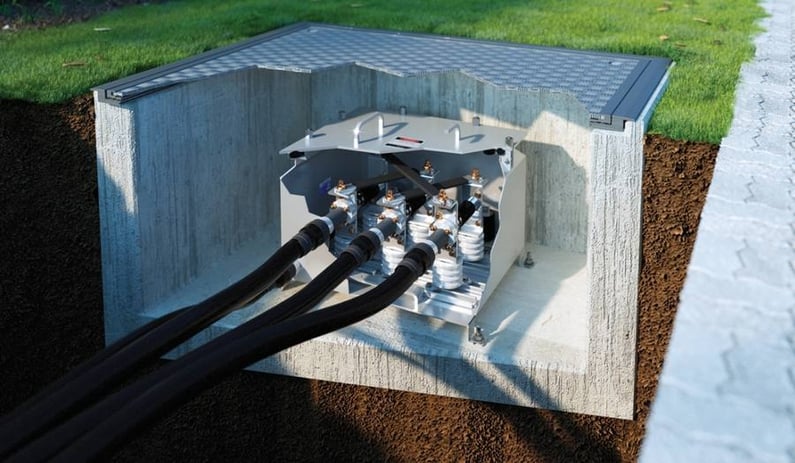
Here’s how cable link boxes affect sheath voltage stress:
Minimizing Induced Voltages and Circulating Currents
In HV cables, the alternating current flowing through the main conductor induces a voltage in the metallic sheath due to electromagnetic induction and capacitive coupling. This induced voltage can lead to circulating currents in the sheath if it is grounded at both ends. These circulating currents cause energy losses, overheating, and can reduce the cable’s current-carrying capacity. Link boxes are installed with cable joints and terminations to prevent these circulating currents and limit the induced voltage on the sheath, ensuring safe operation.
Facilitating Bonding Methods
Link boxes are integral to various cable sheath bonding schemes designed to manage sheath voltages:
- Single-point bonding: In this method, the cable sheath is grounded at only one end, with the other end insulated. This eliminates circulating currents but results in a linearly increasing induced voltage along the cable length. Link boxes can house Sheath Voltage Limiters (SVLs) at the ungrounded end to control this voltage and prevent it from reaching hazardous levels.
- Cross-bonding: This is a more complex and highly effective method for longer HV cable routes. The cable sheath is divided into sections, and these sections are interconnected and transposed in link boxes to balance out the induced voltages. This technique effectively cancels out circulating currents and significantly reduces sheath losses. Cross-bonding link boxes often incorporate SVLs to protect against transient over-voltages.
- Solid bonding: While less common for transmission systems due to high circulating currents and associated losses, solid bonding grounds the sheath at both ends via link boxes. This eliminates standing voltage but requires a significant reduction in the cable’s load rating.
Protection Against Over-voltages
Link boxes, especially when equipped with Sheath Voltage Limiters (SVLs), act as protective barriers against transient over-voltages. These over-voltages can be caused by fault currents, switching operations, or lightning strikes. SVLs are non-linear resistors that provide high impedance under normal conditions but become extremely low-resistance pathways when high voltages occur, safely diverting fault currents to the ground and limiting the voltage induced on the cable sheath. This protection is crucial for preventing insulation breakdown of the cable jacket and ensuring the longevity and reliability of the electrical infrastructure.
Ensuring Safety and Reliability
By effectively managing sheath voltages and providing safe grounding paths during fault conditions, link boxes contribute to human safety and the overall reliability of power distribution networks. They prevent the build-up of dangerous touch voltages on accessible metallic parts and help maintain the integrity of the cable system.