

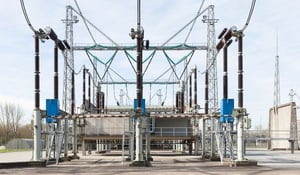
Instrument transformers (ITs), which include Current Transformers (CTs) and Potential Transformers (PTs) or Voltage Transformers (VTs), are critical components in high-voltage substations. They step down high currents and voltages to safe, standardized levels suitable for protection relays and metering equipment, while aiming to maintain proportionality and phase relationships. The accuracy of these ITs directly influences the reliability and effectiveness of the substation’s protection system. Errors introduced by ITs can lead to protective relays receiving inaccurate information, potentially resulting in delayed operation, false tripping, or a complete failure to operate during fault conditions.
The main ways instrument transformers impact the accuracy of substation protection schemes are through:
- Ratio Error This occurs when the actual transformation ratio of the IT deviates from its nominal ratio. It’s caused by the magnetizing current and internal winding losses. For CTs, a ratio error means the secondary current is not an exact scaled-down replica of the primary current; for PTs, the secondary voltage isn’t precisely proportional to the primary voltage. A positive ratio error indicates the secondary current or voltage is larger than the ideal scaled value, while a negative error means it’s lower. These errors can lead to relays misinterpreting fault magnitudes.
- Phase Angle Error This refers to the angular difference between the primary and secondary quantities, which ideally should be zero (or 180 degrees out of phase for CTs in an ideal scenario). Phase angle errors arise from the magnetizing component of the excitation current and internal voltage drops. While often negligible for CT accuracy in relaying, it’s crucial for accurate power measurements and can affect phase comparison schemes in relays.
- Core Saturation A significant factor affecting CT accuracy, especially during high-current fault conditions, is core saturation. When the primary current exceeds the CT’s rated capacity, the core can saturate, leading to a decrease in magnetic permeability and severe distortion of the secondary current waveform. This distortion can cause protective relays to misinterpret the fault current, potentially delaying operation, reducing fault sensitivity, or leading to incorrect differential protection actions if parallel CTs saturate unequally. Protection-class CTs are designed to avoid saturation over a wide range of currents.
- Burden The impedance of the equipment connected to the secondary side of an instrument transformer is known as the burden. The accuracy of an IT depends on this burden. If a CT is overburdened or under-burdened (operating outside 25% to 100% of its rated burden), its accuracy can significantly decrease, increasing errors. An excessive burden can also contribute to CT saturation at lower fault currents.
- Transient Response During system disturbances like faults or overvoltage transients, the output of the IT is used by protective relays to initiate actions. The accuracy and performance of protective relays are directly related to the steady-state and transient performance of the instrument transformers. Large transient errors from ITs may delay or prevent relay operation. For instance, Capacitor Voltage Transformers (CVTs) can introduce transients that reduce the fundamental component of fault voltage, causing distance relays to calculate a smaller-than-actual apparent impedance to the fault.
- Other Influencing Factors Temperature changes can impact the magnetic properties of the core and the resistance of windings. Frequency changes from the rated operating frequency can also introduce errors. A high internal resistance in the secondary winding can cause voltage drops and affect accuracy, while strong external electromagnetic interference can induce additional currents or voltages, interfering with measurements.
Instrument transformers are categorized into accuracy classes, with specific limits for permissible errors for both metering and protection purposes, reflecting different accuracy requirements. Protection ITs require linearity over a wide range of voltages and currents, especially during faults. Properly selecting, installing, and operating ITs according to their specified accuracy is crucial to ensure protective relays function correctly and maintain the stability and safety of the power system.
Need Help Selecting the Right Instrument Transformers?
The accuracy of any protection scheme depends on the quality and performance of its instrument transformers. Selecting the right current transformers (CTs) and voltage transformers (VTs) can help improve fault detection, reduce nuisance trips, and enhance overall network reliability. Insulect supplies a comprehensive range of high-quality instrument transformers for utility, industrial, and renewable energy applications across Australia and New Zealand. If you're planning a new substation, upgrading existing protection systems, or reviewing protection performance, contact our team to discuss the most suitable solution for your application.