

Power-system disturbances don't always occur in an instant. While faults such as short circuits happen in milliseconds, many significant network events develop over seconds or even minutes as generators respond, transmission lines become overloaded, and control systems adjust to changing conditions.
Understanding these slower, evolving events requires a different type of monitoring. This is where Dynamic Disturbance Recording (DDR) plays an important role.
As part of a modern power-system monitoring solution, DDR captures longer-duration system behaviour, providing engineers with valuable insight into how disturbances develop, propagate and ultimately affect network stability.
What Is Dynamic Disturbance Recording?
Dynamic Disturbance Recording (DDR) is the slow-scan, longer-duration disturbance recording function used to monitor dynamic power-system behaviour.
Unlike the high-speed Digital Fault Recorder (DFR) function, which captures detailed waveform data during faults, DDR focuses on recording system parameters over a longer period to analyse how the network responds before, during and after major events.
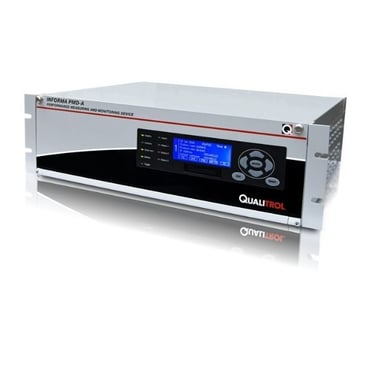
Within the Qualitrol IDM+ platform, DDR is a separate recording function from DFR. It is designed to capture slower-changing electrical conditions over longer periods, where supported by the product configuration.
Typical parameters recorded include:
- Frequency excursions
- Voltage variations
- Active power (MW)
- Reactive power (MVAr)
- Power swings
- Low-frequency electromechanical oscillations
- Generator and inverter-based resource (IBR) response
- Cascading transmission events
- Longer-duration system disturbances
Analysing Slow-Onset and Cascading Disturbances
Many significant power-system events unfold progressively rather than instantaneously.
A disturbance may begin with the loss of a generator or transmission line, causing power to redistribute across the network. As loading increases on neighbouring transmission lines, additional protection systems may operate, potentially leading to further outages.
DDR helps engineers understand this chain of events by recording how system conditions evolve over time.
By reviewing these records, engineers can analyse:
- Changes in transmission-line loading
- Generator responses
- Voltage regulation performance
- Interconnector behaviour
- Cascading network events
This broader system perspective supports more effective disturbance investigations and operational improvements.
Capturing Power Swings and Network Oscillations
Following a major disturbance, different areas of the power system may temporarily oscillate against one another before returning to stable operation.
These low-frequency electromechanical oscillations, commonly known as power swings, are an important indicator of overall system stability.
DDR enables engineers to monitor:
- Voltage behaviour
- Current changes
- Frequency response
- Active power (MW)
- Reactive power (MVAr)
By reviewing these parameters over the duration of an event, engineers can determine whether oscillations are naturally damping or increasing in magnitude, helping assess overall system stability.
Providing Critical Pre-Event and Post-Event Context
While DFR captures high-speed fault waveforms, DDR provides the broader operational context surrounding those events.
This longer-timescale information allows engineers to examine:
- Changing system demand
- Generator output
- Reactive power exchange
- Voltage recovery
- Frequency response
These insights support investigations involving:
- Frequency Control Ancillary Services (FCAS)
- Generator performance
- Battery Energy Storage System (BESS) response
- Transmission network disturbances
- Industrial connection-point performance
Together, DDR and DFR provide a more complete understanding of network behaviour.
Supporting Accurate Power-System Models
Power-system simulation models are widely used to assess network performance and plan future infrastructure.
To remain reliable, these models must be validated against actual system behaviour.
DDR records captured during real-world disturbances provide measured data that engineers can compare with simulation results for:
- Synchronous generators
- Synchronous condensers
- Inverter-based resources
- Large industrial loads
This process helps improve model accuracy, refine system studies and support compliance requirements.
Reconstructing the Sequence of Events
Understanding the precise order in which events occurred is essential when investigating major network disturbances.
DDR data can be correlated with:
- Sequence of Events (SOE) records
- Digital Fault Recorder (DFR) records
- Protection relay information
Combining these complementary data sources enables engineers to reconstruct the sequence of breaker operations, protection trips, voltage changes and frequency response throughout the event.
Rather than relying on a single recording source, engineers gain a comprehensive view of how the disturbance unfolded.
Reducing the Risk of Missing Important Events
Not every significant network event generates a conventional fault trigger.
Some disturbances develop gradually and may not produce the rapid electrical changes required to activate high-speed recording.
Continuous slow-scan DDR monitoring helps reduce the risk of missing these slowly evolving events, ensuring engineers have access to valuable operational data when investigating system performance.
Recording duration, retention period and configuration are determined by the specific Qualitrol product configuration and project requirements.
Supporting Reliable and Resilient Power Systems
As Australia's electricity network evolves through greater renewable energy integration, inverter-based resources and increasingly dynamic operating conditions, understanding how the power system responds to disturbances is becoming more important than ever.
Dynamic Disturbance Recording provides the longer-term operational visibility needed to analyse system behaviour, investigate network events and support informed engineering decisions.
When used alongside Digital Fault Recording (DFR), Sequence of Events (SOE), Power Quality (PQ) monitoring and Phasor Measurement Units (PMUs), DDR forms an essential part of a comprehensive power-system monitoring strategy.
Contact Insulect for DDR Solutions
Insulect supplies and supports Qualitrol's DDRs solutions for transmission utilities, renewable energy projects, mining operations, smelters and large industrial facilities across Australia and New Zealand.
Contact us to discuss how Qualitrol DDR solutions can help your organisation improve disturbance investigations, support FCAS analysis, validate power-system models, and strengthen compliance with National Electricity Rules (NER) and Australian Energy Market Operator (AEMO) requirements where applicable.