

| Company | Griug |
| Location | Norway |
| Timeline | 2026 |
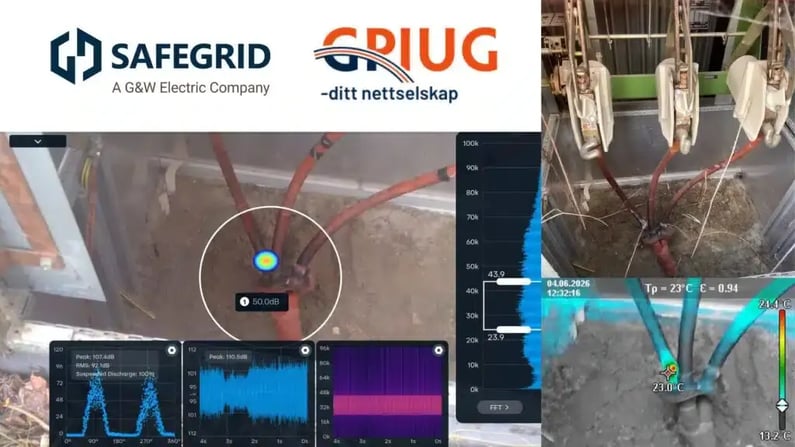
| Project Overview | Safegrid’s Intelligent Grid System® enabled Norwegian utility Griug AS to detect abnormal electrical activity at a secondary substation before it developed into a service-affecting fault. Two Earth Fault (EF) warnings prompted a targeted field inspection, which uncovered a degraded cable termination, a damaged switch component and environmental conditions contributing to equipment deterioration. |
| Products | Safegrid Smart Fault Prediction Tool |
 This is a Safegrid Case Study.
Background
For distribution system operators, developing faults can remain undetected by conventional protection systems until a condition has deteriorated significantly. Early-stage insulation degradation, leakage currents and partial discharge activity can develop over time without triggering protection relays or causing service interruptions.
Norwegian utility Griug AS faced this type of emerging issue at a secondary substation. Safegrid’s Intelligent Grid System® detected abnormal electrical activity and provided early warnings that enabled Griug AS to investigate the affected section of the network before the issue developed further.
Challenge
The developing fault was not visible through Griug AS’s conventional protection systems. No alarms or indications were registered by the utility’s protection relays, meaning the emerging issue could have remained undetected until it resulted in more serious equipment damage or an unplanned outage.
Without continuous monitoring, identifying the affected location would have been difficult, particularly while the network remained operational.
Griug AS needed a way to identify abnormal electrical activity at an early stage and direct field teams to the area requiring investigation.
Solution
Safegrid’s Intelligent Grid System® continuously monitored the network and detected an Earth Fault (EF) warning at 06:25, followed by a second warning at 08:47.
The repeated warnings indicated abnormal electrical activity within the monitored section of the network, despite no corresponding alarms from the utility’s protection relays.
Based on the Safegrid warnings, Griug AS initiated a targeted field inspection of the indicated location.
The investigation identified several issues contributing to the abnormal activity:
-
A heat-shrink cable termination showed signs of degradation.
-
The installed termination was not touch-safe, allowing leakage currents to develop over time.
-
The lower part of a switch had sustained visible damage and was identified as a significant source of electrical noise.
-
Soil had been backfilled up to the substation structure, allowing vegetation to grow inside the switchgear compartment.
Following the inspection, Griug AS replaced the damaged switch component and identified the other conditions requiring corrective attention.
Benefits
Safegrid’s monitoring provided Griug AS with several operational benefits:
Early detection
Abnormal electrical activity was identified before it developed into a service-affecting fault.
Targeted inspection
The warnings directed the utility’s field team towards the affected section of the network, allowing a focused investigation.
Proactive maintenance
Griug AS was able to investigate and address emerging issues rather than waiting for an equipment failure or unplanned outage.
Improved visibility
The case demonstrated how continuous monitoring can identify developing conditions that may not be detected by conventional protection systems.
Results
Safegrid’s Earth Fault Warning functionality enabled Griug AS to identify and investigate an emerging issue while the network was still operating normally.
The field inspection uncovered multiple contributing problems, including a degraded cable termination, leakage-current potential, a damaged switch component and environmental conditions affecting the substation.
The damaged switch component was subsequently replaced, allowing corrective action to be taken before the developing issues escalated.
As Espen Sørlie, Operations Manager at Griug AS, explains:
“Without Safegrid, this issue would likely have remained undetected until it developed further.”
Conclusion
This case demonstrates the operational value of continuous grid monitoring for distribution networks.
While conventional protection systems are essential for detecting significant faults, developing issues may not immediately reach the thresholds required to trigger an alarm. Safegrid’s Intelligent Grid System® provided Griug AS with an earlier indication of abnormal electrical activity and helped pinpoint where further investigation was required.
By turning early warning signals into actionable field inspections, utilities can identify emerging problems sooner, plan maintenance proactively and reduce the risk of developing faults progressing into equipment failure or service interruptions.
As Safegrid’s Australian partner, Insulect helps local utilities and remote network operators gain greater visibility into network faults and turn complex fault data into actionable insights. Talk to our team to learn more.