

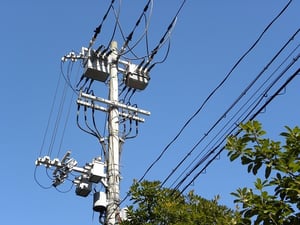
High-voltage substation insulators electrically isolate and mechanically support energised equipment, conductors and busbars in substations. Their selection depends on more than system voltage. Engineers also need to consider insulation levels, creepage distance, pollution severity, mechanical loads, environmental conditions, material and mounting arrangements to ensure the insulator is suitable for its intended application.
What does a high-voltage substation insulator do?
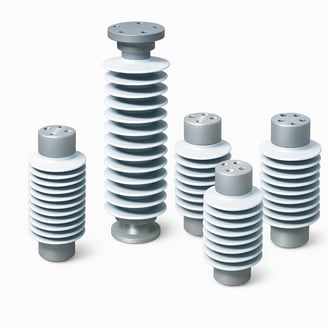
A substation insulator performs two essential functions: it prevents unwanted current paths and supports high-voltage equipment mechanically. Station post insulators commonly support busbars, disconnectors and other substation equipment, while line post and suspension insulators support conductors in overhead applications.
The insulator therefore forms part of both the electrical insulation system and the mechanical structure of the substation.
In an outdoor air-insulated substation, for example, a station post insulator may support a busbar while maintaining the required electrical separation between the energised conductor and the grounded structure.
The insulator must remain electrically effective during normal operation and under specified overvoltage conditions. At the same time, it must withstand mechanical forces imposed by the supported equipment and conductors.
This combination makes insulator selection a system-design decision rather than simply a component purchase.
How do you choose the right substation insulator?
You choose a substation insulator by matching its electrical, mechanical and environmental characteristics to the application. System voltage is only the starting point. The specification should also consider insulation withstand levels, pollution severity, creepage distance, mechanical loading, installation geometry, material and the applicable utility or project requirements.
A typical specification process considers:
- Rated system voltage and highest voltage for equipment
- Lightning impulse and power-frequency withstand levels
- Site pollution severity
- Required creepage distance
- Mechanical loading and cantilever strength
- Installation height and physical dimensions
- Material and housing design
- Mounting and connection arrangements
- Temperature, UV and environmental exposure
- Applicable IEC, AS or utility standards
For a new substation, these requirements should be established during the equipment specification stage.
For a replacement project, the existing insulator, mounting arrangement and electrical requirements should also be reviewed before selecting an equivalent product.
What voltage rating does a substation insulator need?
A substation insulator needs an electrical rating that matches the insulation coordination of the equipment and system. Engineers should not select an insulator solely from the nominal network voltage because the required withstand levels and clearances can also depend on overvoltages, equipment configuration and the overall substation design.
IEEE 1427-2020 provides guidance for recommended electrical clearances and insulation levels in air-insulated substations from 1 kV to 800 kV and includes guidance on coordinating insulation levels with substation clearances.
For an Australian transmission project, for example, a 132 kV or 275 kV application will have specific insulation and mechanical requirements that need to be checked against the project specification rather than assumed from the voltage label alone.
How does pollution affect substation insulator selection?
Pollution affects insulator performance because contaminants deposited on an outdoor insulator can become conductive when wet. Engineers therefore need to consider the site's pollution severity when determining the required creepage distance and selecting the insulator design and material.
The current IEC TS 60815-1:2025 provides general principles for selecting and dimensioning high-voltage outdoor insulators in polluted conditions. It includes methods for evaluating site pollution severity (SPS) and determining the relevant creepage requirements for candidate insulators.
IEC TS 60815-2:2025 provides specific guidance for ceramic and glass insulators used on AC systems in outdoor polluted environments.
This is particularly relevant to substations located near:
- Coastal areas
- Industrial facilities
- Mining operations
- Agricultural areas
- Dusty or dry environments
- Areas exposed to salt spray
For example, an outdoor substation near the coast may require a different creepage arrangement from an otherwise similar installation located well inland.
What is creepage distance and why does it matter?
Creepage distance is the distance measured along the insulating surface between conductive parts at different electrical potentials. A longer creepage path can help an outdoor insulator withstand surface leakage caused by contamination and moisture.
The required creepage distance should be determined as part of the insulation design rather than selected as a generic number for a particular voltage.
IEC TS 60815-1:2025 establishes the general approach for determining pollution severity and the reference unified specific creepage distance, while the relevant parts of the series provide guidance for different insulator technologies.
The shed profile also matters. Two insulators with the same overall height may not provide identical pollution performance because their surface geometry can affect how contamination and moisture behave.
For a substation in a high-contamination environment, this can become an important consideration when selecting a replacement insulator.
What mechanical loads must a station post insulator withstand?
A station post insulator must withstand the mechanical loads transferred through the equipment it supports. These can include cantilever, tension, compression and torsional loads, depending on the application and design.
IEC 62231-1:2015 specifies dimensional, mechanical and electrical characteristics for composite station post insulators used in AC substations above 1,000 V up to 245 kV. The associated IEC 62231 standard addresses mechanical loading including cantilever, torsion, tension and compression.
In practical terms, engineers need to consider more than the weight of a busbar.
For example, a station post supporting a rigid busbar may experience forces associated with conductor configuration, wind, thermal expansion and short-circuit conditions. The insulator, fittings and supporting structure therefore need to be considered as a complete mechanical arrangement.
Is porcelain or composite better for a substation?
Porcelain and composite insulators can both be suitable for substation applications, but their characteristics are different. Porcelain provides a long-established insulation solution, while composite designs can reduce weight and use polymeric housings to provide different surface and environmental characteristics.
Composite station post insulators generally consist of a load-bearing fibre-reinforced core, an external polymer housing and metal end fittings. IEC 62231-1:2015 defines the dimensional, mechanical and electrical characteristics for composite station post insulators within its scope.
Composite technology can be particularly useful where weight, handling, pollution performance or seismic considerations are important.
Manufacturer information also shows composite station post designs being used for applications such as busbar supports, disconnectors and reactors. Hitachi Energy, for example, publishes composite station post products covering applications extending to high-voltage substation equipment.
However, the choice between porcelain and composite should be based on the project specification, environment, mechanical requirements and applicable standards rather than material preference alone.
How does silicone rubber affect composite insulator performance?
Silicone rubber can help a composite insulator manage contamination and moisture because its surface can retain hydrophobic characteristics. This can reduce the tendency for water to form a continuous conductive film across the surface.
Hydrophobicity is particularly relevant to outdoor insulation because surface wetting affects leakage current and pollution performance.
IEC TS 62073:2016 provides methods for measuring the hydrophobicity of insulator surfaces, including composite insulators used in substations and electrical equipment. The IEC page records a corrected version issued in 2026.
Manufacturer information for silicone-rubber composite insulators also identifies hydrophobicity, pollution performance and UV stability as important characteristics of the technology.
The important point is that hydrophobicity should not be considered in isolation. The complete insulator design, pollution environment, creepage distance and material system all influence field performance.
What standards apply to high-voltage substation insulators?
The applicable standard depends on the insulator construction and application. Engineers should confirm the relevant standard against the project specification rather than assuming that one standard covers every type of insulator.
Common references include:
| Standard | Relevance |
|---|---|
| IEC 60168 | Tests for indoor and outdoor post insulators made from ceramic or glass |
| IEC 62231-1:2015 | Dimensional, mechanical and electrical characteristics of composite station post insulators |
| IEC TS 60815-1:2025 | General selection and dimensioning principles for outdoor HV insulators in polluted conditions |
| IEC TS 60815-2:2025 | Selection and dimensioning of ceramic and glass insulators for AC systems in polluted conditions |
| IEC TS 62073:2016 | Measurement of hydrophobicity of insulator surfaces |
| IEC 62772:2023 | Composite hollow-core station post insulators |
| IEEE 1427-2020 | Electrical clearances and insulation levels in air-insulated substations |
| IEEE 957-2024 | Monitoring, managing and cleaning contaminated insulators |
IEC 60168 covers ceramic and glass post insulators for indoor and outdoor use above 1,000 V. IEC 62772:2023 covers composite hollow-core station post insulators for AC systems above 1,000 V and DC systems above 1,500 V.
IEEE 957-2024 provides guidance for monitoring, managing and cleaning contaminated electrical insulators.
What should you check when replacing an existing substation insulator?
When replacing an existing insulator, engineers should compare the new unit against the original electrical, mechanical and physical requirements. A replacement that fits the mounting holes may still be unsuitable if its insulation level, creepage distance or mechanical rating differs from the original design.
The replacement assessment should include:
- Voltage and insulation withstand requirements
- Creepage distance
- Pollution severity
- Mechanical loading
- Overall height
- Mounting dimensions
- Bolt pattern
- Conductor or equipment interface
- Material and insulator construction
- Applicable network or utility specification
This is particularly important for ageing substations where the original manufacturer or model may no longer be available.
A technically suitable replacement may require a different physical design, so the complete interface should be checked before ordering.
How should substation insulators be maintained?
Substation insulator maintenance should focus on the conditions that can affect electrical and mechanical performance, including contamination, surface damage, ageing, loose or damaged fittings and changes to the surrounding environment.
The required maintenance approach depends on the insulator type, site conditions and network owner's procedures.
For contaminated installations, IEEE 957-2024 provides guidance covering the monitoring, management and cleaning of contaminated electrical insulators.
In practice, inspection teams may look for:
- Cracks or physical damage
- Surface contamination
- Evidence of tracking or flashover
- Damaged sheds on polymeric insulators
- Corrosion of metal fittings
- Loose mounting hardware
- Changes in site contamination
- Unusual electrical discharge activity
A coastal or industrial substation may require a different inspection and cleaning strategy from a relatively clean inland site.
Where are high-voltage substation insulators used?
High-voltage substation insulators are used wherever electrical insulation and mechanical support are required between energised equipment and grounded structures.
Typical applications include:
- Busbar supports
- Disconnectors and isolators
- Circuit breaker assemblies
- Reactors
- Outdoor switchyards
- Overhead line connections
- Renewable energy substations
- Transmission substations
- Distribution substations
- Industrial substations
Insulect's current range includes station post insulators in porcelain solid-core construction, as well as polymeric and porcelain line post insulators and porcelain and glass disc suspension insulators. The published range covers applications from 12 kV through 550 kV, depending on product type.
For example, Insulect supplied 33 kV and 275 kV post insulators as part of the Tarong Battery Energy Storage System project, alongside other high-voltage equipment.
How can Insulect help with substation insulator selection?
Insulect can help customers match substation insulators to electrical, mechanical, environmental and physical requirements. Its published range includes station post, line post and disc suspension insulators, with options for different voltage levels, creepage requirements, mechanical ratings and mounting arrangements.
For new projects, the relevant technical information can be reviewed during specification.
For retrofit applications, existing drawings, dimensions and insulator details can be used to assess replacement options.
Explore Insulect High-Voltage Substation Insulators
FAQs
Insulect Can Help You Specify the Right Substation Insulator
Choosing a high-voltage substation insulator requires more than matching a voltage number. The right solution needs to balance electrical insulation, mechanical loading, creepage distance, pollution severity, environmental exposure and physical interfaces.
Insulect supplies high-voltage substation insulators for transmission, distribution, renewable energy and industrial applications. If you are specifying a new installation or replacing an existing insulator, Insulect can help assess the application and identify a suitable product configuration.
Talk to Insulect about your substation insulator requirements.
Sources and technical references
- IEC TS 60815-1:2025, Selection and dimensioning of high-voltage insulators intended for use in polluted conditions – Part 1: Definitions, information and general principles.
- IEC TS 60815-2:2025, Selection and dimensioning of high-voltage insulators intended for use in polluted conditions – Part 2: Ceramic and glass insulators for a.c. systems.
- IEC 62231-1:2015, Composite station post insulators for substations with AC voltages greater than 1,000 V up to 245 kV.
- IEC 62772:2023, Composite hollow core station post insulators.
- IEC TS 62073:2016, Guidance on the measurement of hydrophobicity of insulator surfaces.
- IEC 60168, Tests on indoor and outdoor post insulators of ceramic material or glass.
- IEEE 1427-2020, Guide for Recommended Electrical Clearances and Insulation Levels in Air Insulated Electrical Power Substations.
- IEEE 957-2024, Guide for Monitoring, Managing, and Cleaning of Contaminated Insulators.